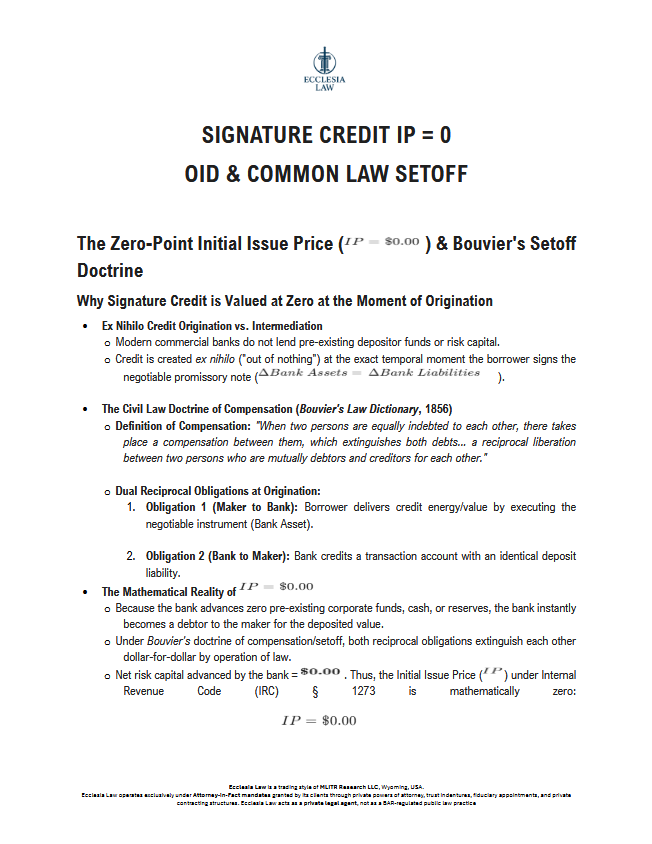
The Zero-Point Initial Issue Price (IP = $0.00) & Bouvier’s Setoff Doctrine
Why Signature Credit is Valued at Zero at the Moment of Origination
- Ex Nihilo Credit Origination vs. Intermediation
- Modern commercial banks do not lend pre-existing depositor funds or risk capital.
- Credit is created ex nihilo (“out of nothing”) at the exact temporal moment the borrower signs the negotiable promissory note (Bank Assets = ΔBank Liabilities).
The Civil Law Doctrine of Compensation (Bouvier’s Law Dictionary, 1856)
- Definition of Compensation: “When two persons are equally indebted to each other, there takes place a compensation between them, which extinguishes both debts… a reciprocal liberation between two persons who are mutually debtors and creditors for each other.”
- Dual Reciprocal Obligations at Origination:
- Obligation 1 (Maker to Bank): Borrower delivers credit energy/value by executing the negotiable instrument (Bank Asset).
- Obligation 2 (Bank to Maker): Bank credits a transaction account with an identical deposit liability.
The Mathematical Reality of IP = $0.00
- Because the bank advances zero pre-existing corporate funds, cash, or reserves, the bank instantly becomes a debtor to the maker for the deposited value.
- Under Bouvier’s doctrine of compensation/setoff, both reciprocal obligations extinguish each other dollar-for-dollar by operation of law.
- Net risk capital advanced by the bank = $0.00. Thus, the Initial Issue Price (IP) under Internal Revenue Code (IRC) § 1273 is mathematically zero: IP = $0.00
Original Issue Discount (OID) & The “Can’t Have It Both Ways” Paradox
Negotiable Instruments, Backup Withholding, and Institutional Duality
The Mathematical Formulation of OID (IRC § 1273)
- Original Issue Discount (OID) is defined as the excess of the stated redemption price at maturity (FV) over the initial issue price (IP):
OID = Stated Redemption Price at Maturity (FV) – Initial Issue Price (IP) - Applying the zero-point baseline IP = $0.00 : OID = FV − $0.00 = FV
- Conclusion: The OID generated by the instrument is equivalent to the entire face value (FV) of the note.
The “Can’t Have It Both Ways” Bank Paradox
- Foreclosure Standing: Banks assert standing in court by presenting physical promissory notes under Uniform Commercial Code (UCC) Article 3 / Bills of Exchange Act 1882, claiming the note is a liquid, transferable negotiable instrument.
- Tax Avoidance Position: Banks simultaneously deny the instrument’s negotiable status when attempting to bypass OID reporting and accounting liabilities under IRC § 1273.
- Legal Estoppel: Banks cannot treat an instrument as negotiable to seize real property while denying its negotiability to evade federal tax accounting.
Generation of Backup Withholding Tax Liabilities
- Because IP = $0.00 and future market value is high (FV), the spread creates massive OID discount income.
- Institutions holding OID paper act as nominee middlemen under IRS Publication 1212.
- This triggers statutory nonpayroll backup withholding tax duties (24%) remitted under the bank’s Form 945 tax module (Master File Transaction MFT 16).
Rebutting Securitization Claims: Why Bank Arguments Collapse Under Common Law Setoff
Why Secondary Market Pooling Cannot Overcome Baseline Setoff Rights
The Bank’s Securitization Defence
- Institutional Claim: Banks argue that because a mortgage note was securitized, assigned a CUSIP/ISIN, and sold into secondary market trusts (SPVs) for face value, the initial issue price must have been the full face value (IP = FV).
Why the Securitization Argument Collapses
- Temporal Sequence of Origination: Securitization occurs downstream. The initial issue price (IP) is fixed at the moment of creation, where net capital advanced was zero (IP = $0.00).
- Common Law Setoff Transcends Transfers (Bouvier’s): Under common law setoff and UCC § 3-203/§ 3-302, a transferee or secondary market trust takes subject to all underlying defenses and setoff claims existing at origination. Downstream pooling cannot retroactively create historical risk capital that the originating bank never advanced.
The Principle of Nemo Dat Quod Non Habet
“No one can give what they do not have.” An originating lender cannot assign greater beneficial rights than it possessed.
- If the underlying debt was compensated/set off to zero at the apex ledger level upon execution, the accessory mortgage/security interest holds no independent legal force (accessorium sequitur principale):
- Principal Debt = $0.00
- Accessory Security Inte
Summary
- Signature credit originates at IP = $0.00
- Common law setoff (Bouvier’s) extinguishes the bank’s claim of risk capital.
- Securitization merely trades an OID derivative; it does not change the initial zero-point baseline.